

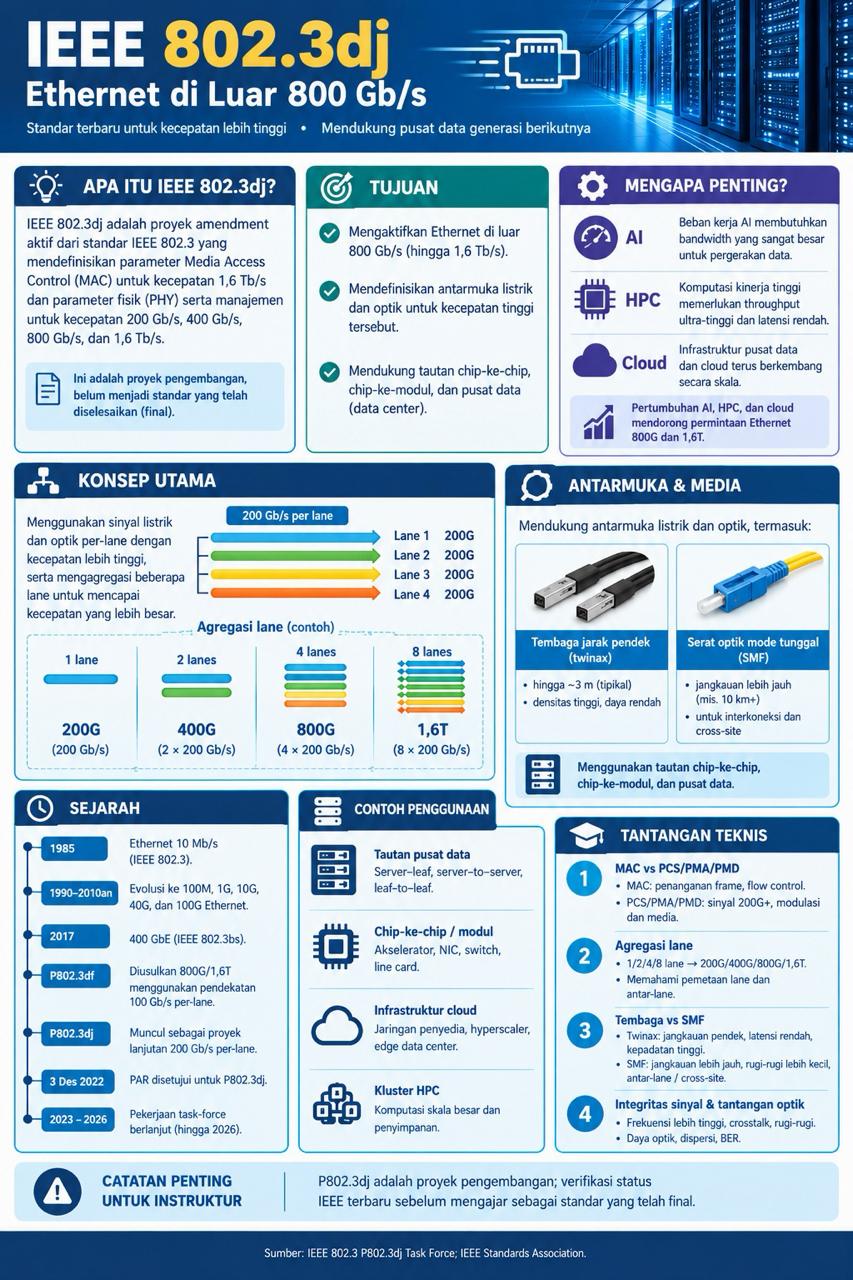
The rapid evolution of digital technology continues to increase the demand for faster, more reliable, and more efficient computer networks. The growth of Artificial Intelligence (AI), cloud computing, High-Performance Computing (HPC), and modern data centers requires network infrastructure capable of transmitting massive amounts of data at unprecedented speeds.
To address these challenges, the Institute of Electrical and Electronics Engineers (IEEE) is developing IEEE 802.3dj, a next-generation Ethernet amendment project designed to support transmission speeds of 200 Gbps, 400 Gbps, 800 Gbps, and up to 1.6 Terabits per second (Tbps).
This development represents a significant milestone in Ethernet technology, paving the way for higher-capacity networks that can support the growing demands of modern digital infrastructure.
What Is IEEE 802.3dj?
IEEE 802.3dj is an amendment project within the IEEE 802.3 Ethernet standards framework that aims to develop networking technologies capable of delivering data transmission speeds of up to 1.6 Tbps.
The project includes Media Access Control (MAC) parameters for 1.6 Tbps Ethernet, as well as Physical Layer (PHY) specifications and management parameters supporting 200 Gbps, 400 Gbps, 800 Gbps, and 1.6 Tbps Ethernet.
In simple terms, IEEE 802.3dj is intended to enable networking devices such as switches, servers, and data center equipment to communicate using significantly higher bandwidth than previous Ethernet generations.
To put this into perspective, 1.6 Tbps is equivalent to 1,600 Gbps or 1,600,000 Mbps.
This means that a 1.6 Tbps Ethernet connection theoretically offers 16 times the bandwidth capacity of a 100 Gbps Ethernet connection.
However, as of October 2026, IEEE 802.3dj remains under development and has not yet been finalized as an officially approved standard.
Why Is 1.6 Tbps Ethernet Important?
The increasing reliance on digital services and advanced computing technologies is creating unprecedented demand for high-speed networking solutions.
Several key factors are driving the development of Ethernet technology capable of reaching 1.6 Tbps.
1. The Rapid Growth of Artificial Intelligence (AI)
Artificial Intelligence applications require enormous computational resources and extensive data exchange between processing systems.
Training large-scale AI models often involves thousands of GPUs and specialized computing accelerators operating simultaneously.
These interconnected systems require high-bandwidth networks to exchange data efficiently and minimize communication bottlenecks.
Ethernet speeds of 800 Gbps and 1.6 Tbps are expected to play an important role in supporting future AI infrastructure and large-scale machine learning environments.
2. Expansion of Cloud Computing
Cloud computing enables organizations to store, process, and access data through interconnected computing infrastructure.
As more businesses and individuals adopt cloud-based applications, the volume of data traveling between cloud servers continues to increase.
Next-generation Ethernet technologies can help cloud providers improve their internal network capacity, supporting greater workloads, higher scalability, and more efficient data communication.
3. High-Performance Computing (HPC) Requirements
High-Performance Computing involves powerful computing systems designed to perform complex calculations and process massive datasets.
HPC is widely used in scientific research, weather forecasting, molecular modeling, engineering simulations, and advanced data analytics.
These systems depend on high-speed interconnections between processors, storage systems, and computing clusters.
Ethernet technology with speeds of up to 1.6 Tbps can provide additional bandwidth capacity for demanding HPC environments.
4. Modernization of Data Center Infrastructure
Modern data centers contain thousands of interconnected servers, switches, storage devices, and networking systems.
The continuous increase in internal data traffic requires higher network capacity to maintain efficient communication.
Ethernet 1.6 Tbps is being developed to help data centers accommodate growing bandwidth requirements while improving network scalability and connection density.
How Does 1.6 Tbps Ethernet Work?
One of the key concepts behind IEEE 802.3dj is the development of high-speed transmission lanes capable of carrying approximately 200 Gbps per lane.
A lane is an individual data transmission path that can be combined with other lanes to achieve higher total bandwidth.
By aggregating multiple lanes, Ethernet interfaces can support different transmission capacities.
The following table illustrates this concept:
| Lane Configuration | Theoretical Bandwidth |
|---|---|
| 1 × 200 Gbps lane | 200 Gbps |
| 2 × 200 Gbps lanes | 400 Gbps |
| 4 × 200 Gbps lanes | 800 Gbps |
| 8 × 200 Gbps lanes | 1.6 Tbps |
For example, combining eight lanes operating at 200 Gbps each can provide an aggregate bandwidth of 1.6 Tbps.
This approach allows networking systems to achieve higher data transmission speeds through multiple parallel communication channels.
However, the table represents a simplified illustration. Actual Ethernet implementations depend on the relevant electrical and optical interface specifications, signaling methods, and physical-layer designs.
Transmission Media for 1.6 Tbps Ethernet
The development of ultra-high-speed Ethernet focuses not only on increasing bandwidth but also on improving the physical transmission technologies used to transport data.
IEEE 802.3dj includes the development of electrical and optical interfaces to support high-capacity networking.
1. Copper Cables for Short-Distance Connections
Copper-based transmission media continue to play an important role in networking infrastructure, particularly for short-distance connections between nearby devices.
In data center environments, high-speed copper connections can be used to interconnect equipment within or between adjacent racks.
Potential advantages include lower costs for certain short-distance deployments, relatively straightforward implementation, and favorable power efficiency in suitable configurations.
However, higher transmission speeds introduce additional challenges related to signal integrity, attenuation, and electromagnetic interference.
Maintaining reliable communication at extremely high speeds requires advanced engineering and careful system design.
2. Fiber Optic Technology for High-Capacity Networking
Fiber optic technology is another essential component of next-generation Ethernet development.
Unlike copper cables, fiber optic connections transmit information using light signals.
Optical networking supports high-bandwidth communication over distances determined by the transceiver design, fiber characteristics, and applicable Ethernet specifications.
In modern data centers, fiber optic connections are commonly used to interconnect switches, servers, and large-scale networking equipment.
Optical interfaces developed under IEEE 802.3dj are intended to address the increasing demand for high-capacity communication across advanced computing infrastructure.
The Evolution of Ethernet Technology
Ethernet has evolved significantly since its introduction, becoming one of the most widely adopted networking technologies worldwide.
Over several decades, Ethernet speeds have increased from megabits per second to hundreds of gigabits per second.
The following timeline highlights major milestones in Ethernet development.
| Period | Ethernet Development |
|---|---|
| 1980s | 10 Mbps Ethernet |
| 1990s | 100 Mbps Fast Ethernet |
| Late 1990s | 1 Gbps Gigabit Ethernet |
| 2000s | 10 Gbps Ethernet |
| 2010s | 40 Gbps and 100 Gbps Ethernet |
| 2017 | 400 Gbps Ethernet standardized through IEEE 802.3bs |
| 2020s | Development and adoption of 800 Gbps Ethernet |
| 2023–2026 | IEEE P802.3dj development toward 1.6 Tbps Ethernet |
This evolution demonstrates how networking technologies continue to adapt to the increasing demands of digital communication.
Compared with early 10 Mbps Ethernet, a 1.6 Tbps connection offers a theoretical bandwidth capacity 160,000 times greater.
Such improvements highlight the extraordinary progress achieved in network communication technology.
Applications of 1.6 Tbps Ethernet
Ethernet technology supporting speeds of up to 1.6 Tbps is expected to benefit industries that rely on large-scale computing and high-capacity data communication.
1. Large-Scale Data Centers
High-speed Ethernet can support communication between switches, servers, and storage systems within hyperscale data centers.
It can also provide additional bandwidth for modern leaf-spine network architectures designed to handle substantial east-west traffic.
2. Artificial Intelligence Infrastructure
AI computing environments often require extensive communication between GPUs, processing accelerators, and distributed computing systems.
Next-generation Ethernet technology can provide higher-capacity connections to support data-intensive AI workloads.
3. Cloud Service Providers
Cloud service providers continuously expand their computing and storage infrastructure to accommodate increasing customer demand.
Higher-speed Ethernet interfaces can help improve network capacity and support the delivery of large-scale cloud services.
4. Scientific Research and High-Performance Computing
Research institutions and advanced computing facilities require powerful networks to connect processing clusters.
Ethernet 1.6 Tbps could support high-bandwidth communication within systems used for scientific simulations, computational research, and large-scale data processing.
5. Future Digital Infrastructure
The increasing adoption of advanced analytics, automation, and distributed computing creates new networking requirements.
High-capacity Ethernet technologies can contribute to the development of scalable digital infrastructure capable of supporting future applications.
Technical Challenges of Implementing 1.6 Tbps Ethernet
Despite its promising capabilities, implementing Ethernet at speeds of up to 1.6 Tbps presents several technical challenges.
Signal Integrity and Reliability
Extremely high transmission speeds require sophisticated techniques to maintain signal quality.
Issues such as noise, crosstalk, signal distortion, and attenuation must be carefully managed to ensure reliable data transmission.
Power Consumption and Cooling
High-performance networking equipment requires suitable electronic components, optical transceivers, and cooling systems.
Improving energy efficiency is particularly important for hyperscale data centers operating thousands of interconnected devices.
Infrastructure Compatibility
Deploying 1.6 Tbps Ethernet requires compatible switches, transceivers, cabling systems, and networking interfaces.
Organizations must evaluate their existing infrastructure before implementing next-generation Ethernet technologies.
Implementation Costs
Advanced networking equipment can require substantial investment.
IT administrators must carefully consider actual bandwidth requirements, scalability, equipment costs, operational expenses, and long-term infrastructure planning.
IEEE 802.3dj Development Status in 2026
IEEE P802.3dj has undergone multiple stages of technical development, review, and evaluation since its project authorization was approved in December 2022.
Throughout 2026, the proposed amendment continued through IEEE standards development and ballot procedures.
In August 2026, the second Standards Association recirculation ballot achieved an approval rate of approximately 86%.
The subsequent third recirculation ballot for Draft D3.3 was scheduled from September 25 to October 10, 2026.
Therefore, as of October 8, 2026, IEEE P802.3dj remains in the standardization process and should not yet be described as a finalized IEEE standard.
This distinction is important when discussing emerging networking technologies, as technical specifications may continue to evolve before formal approval.
The Future of Ethernet and High-Speed Networking
The development of Ethernet technology capable of reaching 1.6 Tbps demonstrates the growing importance of network infrastructure in the digital economy.
Artificial Intelligence, cloud computing, HPC, and large-scale data processing are creating new requirements for faster and more scalable communication networks.
Future networking infrastructure will increasingly depend on technologies capable of delivering high bandwidth while maintaining reliability, energy efficiency, and operational scalability.
IEEE 802.3dj represents an important step toward meeting these requirements and shaping the future of high-speed Ethernet communication.
For IT professionals and network administrators, understanding these developments can help support long-term technology planning and infrastructure modernization.
Conclusion
Ethernet speeds of up to 1.6 Tbps, being developed through IEEE 802.3dj, represent a major advancement in next-generation networking technology.
By supporting the development of Ethernet interfaces ranging from 200 Gbps to 1.6 Tbps, this initiative aims to address the increasing bandwidth demands of modern data centers, Artificial Intelligence systems, cloud computing platforms, and High-Performance Computing environments.
Although the IEEE 802.3dj amendment is still undergoing standardization as of October 2026, its development highlights the direction of future Ethernet networks: higher bandwidth, improved scalability, and increasingly sophisticated communication infrastructure.
Understanding the evolution of Ethernet technology is essential for IT professionals, network engineers, and organizations preparing for the next generation of digital transformation.
References
IEEE Standards Association – IEEE P802.3dj
https://standards.ieee.org/ieee/802.3dj/11115/IEEE P802.3dj Task Force
https://www.ieee802.org/3/dj/public/index.htmlIEEE 802.3 Ballot Announcements
https://ieee802.org/3/ballots/announce.html