
Directorate of Information Systems and Technology – When using the internet, every device requires an addressing mechanism so that data can be sent to the correct destination. One component that plays this role is the Internet Protocol Address, or IP address. IP addresses are used in communication processes on Internet Protocol-based networks. Through these addresses, devices can be logically identified and data packets can be directed from source to destination. IP addresses are used in various digital activities, from opening websites and using online services to communicating between devices on a local network.
So, what is an IP address, how does it work, and what are its types? Here’s a complete explanation.
IP Addresses
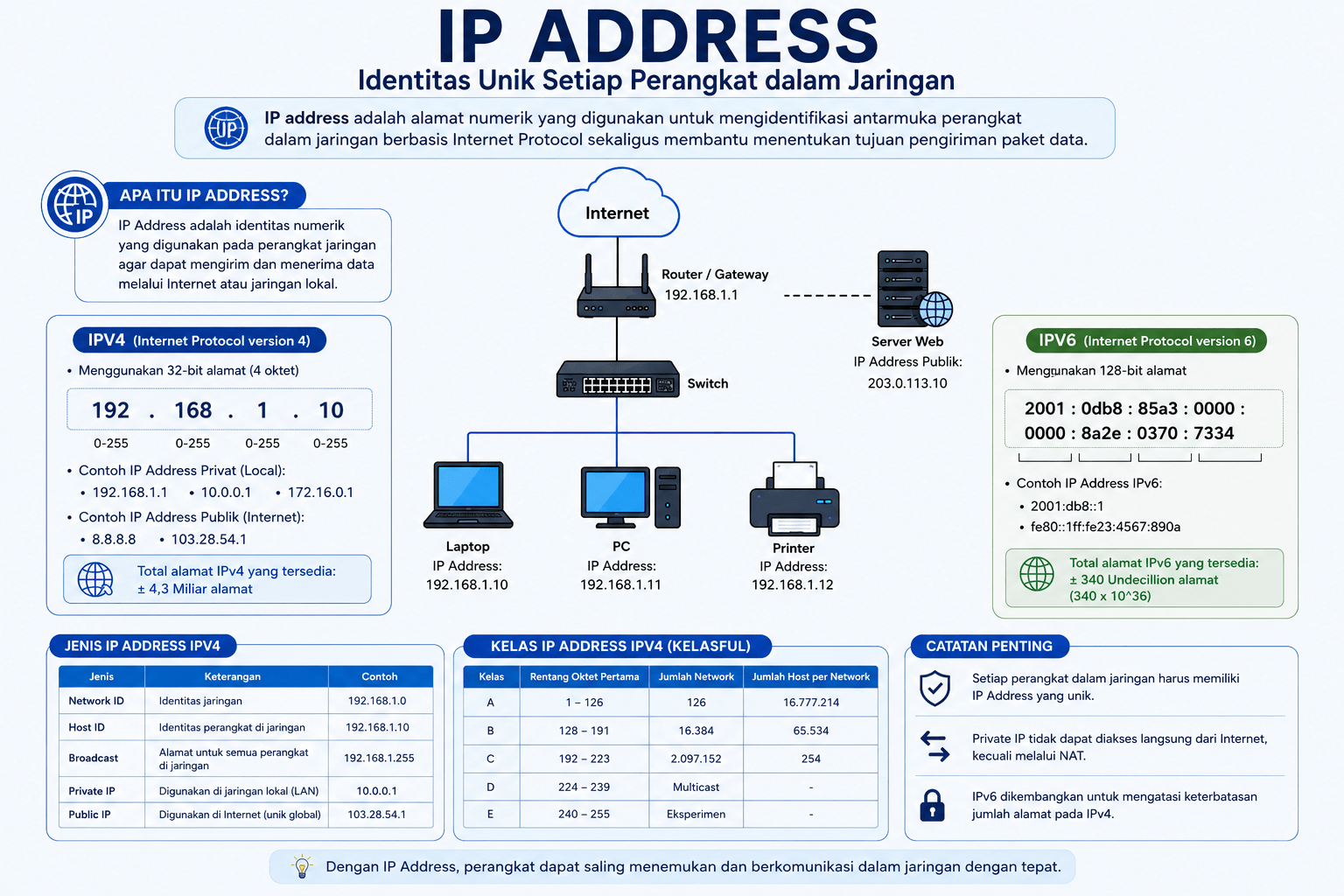
An IP address is a numeric address used to identify a device’s interface on an Internet Protocol-based network and to help determine the destination of data packets. Simply put, an IP address can be likened to an address in a network communications system. When a device sends data, the IP address information helps the network identify the source and destination of the packet.
Currently, there are two commonly known versions of the Internet Protocol: IPv4 and IPv6. Both have different writing formats.
IPv4 example:
192.168.1.1
Meanwhile, an IPv6 example is:
2001:db8:85a3::8a2e:370:7334
IPv4 uses 32-bit addresses, while IPv6 uses 128 bits. IPv6’s much larger capacity allows for a vast address space to meet the ever-growing needs of network devices and services.
IP Address Function
The existence of an IP address is an essential part of network communication. Some of its main functions include:
- Providing Logical Identity to Devices
IP addresses help distinguish devices or network interfaces that are communicating. Computers, mobile phones, servers, and various other devices can use IP addresses when connected to an IP-based network.
- Assisting in Data Packet Delivery
Each IP packet carries information about the source and destination addresses. This information is used by network devices, including routers, to help forward packets to their destination network.
- Supporting Network Administration
Administrators can utilize IP address information for various management purposes, such as device configuration, connection monitoring, implementing access rules, and troubleshooting when disruptions occur.
- Providing an Approximate Connection Origin
Public IP addresses can be used to estimate the location of a connection based on IP geolocation information. However, the results do not always pinpoint the user’s exact physical location. Accuracy can vary and usually only provide an approximate location, depending on the available data.
How Does an IP Address Work?
When a device joins a network, it requires an IP configuration to communicate using the Internet Protocol. These addresses can be configured manually or obtained automatically, depending on the network system used.
Simply put, the communication process can be described as a user opening an internet service. Data from the device is packaged into packets and equipped with the necessary addressing information.
The packets are then forwarded through the network. The router reads the destination information and determines where the packet should be forwarded next until it reaches the destination network. At the receiving end, the data is processed according to the protocol and application used.
IP addresses themselves can be assigned using different methods, including:
- A static IP address is an address configured to remain consistent and is typically used when a service requires a predictable address.
- A dynamic IP address is an address that can be allocated automatically and changed according to network policy. In many networks, this mechanism is implemented using DHCP (Dynamic Host Configuration Protocol).
Types of IP Addresses
IP addresses can be grouped based on protocol version, scope of use, and allocation method. Here are some important categories to know.
- IPv4 and IPv6
- IPv4 (Internet Protocol version 4)
IPv4 uses a 32-bit addressing system. Its format is typically displayed as four decimal numbers separated by periods, for example, 192.168.1.1.
The limitations of the IPv4 address space have become increasingly apparent as the need for internet connectivity increases. Various technologies, including NAT, have been widely used to help optimize the use of IPv4 addresses.
- IPv6 (Internet Protocol version 6)
IPv6 uses a 128-bit address space, providing a much larger address capacity than IPv4. It is written using hexadecimal numbers separated by colons.
IPv6 was developed to address the long-term needs of internet address space while also introducing several changes to the Internet Protocol mechanism.
- Public and Private IP Addresses
- Public IP Addresses
Public IP addresses are used for internet communications and come from a globally routable address space. To avoid conflicts within the global internet system, their allocation follows a coordinated address management mechanism.
It’s important to understand that having a public IP address doesn’t automatically grant a device or service free internet access. Access still depends on network configuration, firewalls, available services, and other security policies.
- Private IP Addresses
Private IP addresses are used for communication within internal networks. This type of address is commonly found in home, office, school, and organizational networks.
Private IPv4 addresses are not routed directly through the public internet. On many networks, devices with private addresses access the internet through a router or gateway that implements a mechanism such as NAT (Network Address Translation).
- Static and Dynamic IP Addresses
- Static IP
Static addresses are designed to avoid frequent changes. Consistent use of addresses can facilitate access to certain servers or network services that require fixed addresses.
- Dynamic IP
Dynamic addresses are allocated for a specific period and can change. DHCP is a mechanism commonly used to automatically assign IP configurations to devices, especially on local networks.
How Are IP Addresses Distributed?
Internet number resource management is carried out hierarchically to ensure globally coordinated use.
At the global level, the Internet Assigned Numbers Authority (IANA) coordinates internet number resources. Address resources are then managed through five Regional Internet Registries (RIRs) serving different regions of the world.
These five RIRs are AFRINIC, APNIC, ARIN, LACNIC, and RIPE NCC. Through this regional registry system, address resources can be allocated to various organizations according to applicable policies. In practice, internet customers can obtain IP addresses through their internet service providers (ISPs). Meanwhile, on local networks, devices such as routers often run DHCP services to assign private address configurations to user devices. With this layered mechanism, address management can be carried out from the global level down to the local network.
Security Risks Associated with IP Addresses
IP addresses are crucial information in network communications. While knowing an IP address alone doesn’t automatically allow someone to take over a device, there are a number of security and privacy risks that need to be considered.
- DDoS Attacks
In a Distributed Denial of Service (DDoS) attack, an attacker can send massive amounts of traffic to a service or infrastructure. As a result, available resources can be overwhelmed, slowing down or making the service unusable for legitimate users.
- IP-Based Geolocation
Public IP addresses can be used to obtain the approximate location of a connection. The resulting information is generally not equivalent to precise location data like GPS, but it can still be a privacy consideration.
- IP Spoofing
IP spoofing is the technique of forging the source IP address of network packets to make them appear to originate from another address. This technique can be used in certain attack scenarios, including as part of reflection or amplification attacks.
- Service Scanning
IP addresses reachable from the internet can be targeted for scanning to find open services or ports. If a service has a weak configuration or unpatched vulnerabilities, security risks can increase.
Therefore, network security should not rely solely on IP address hiding. The use of firewalls, system updates, strong authentication, encryption, restrictions on exposed services, and security monitoring are some measures that can be implemented.
VPNs (Virtual Private Networks) can also be used in certain circumstances to create an encrypted connection to a VPN server. When accessing the internet through a VPN, the destination service will generally see the VPN server’s public IP address as the connection source, not the user’s initial public IP address. However, a VPN is not a substitute for all device and network security mechanisms.
Blockchain and Data Security in Network Infrastructure
In addition to conventional security mechanisms, blockchain technology has also been developed for various scenarios that require distributed data logging and record integrity.
The characteristics of blockchain allow records to be stored in a structure that makes changes to historical data easier to detect. In certain contexts, this approach can be utilized for activity logging, information verification, or auditing purposes.
However, blockchain does not automatically make IP addresses secure or prevent attacks such as DDoS and IP spoofing. Its effectiveness depends on the system design and the use case being implemented. Therefore, this technology is best viewed as an approach that can complement certain security systems, rather than as a replacement for network protections such as firewalls, encryption, authentication, and security monitoring.
So, What Is an IP Address?
An IP address is an addressing component that plays a fundamental role in Internet Protocol-based network communications. This address helps devices and network infrastructure identify the source and destination so that data packets can be forwarded to the appropriate network. IP addresses come in various categories, from IPv4 and IPv6, public and private addresses, to static and dynamic addresses. Each is used according to network needs and configurations.
Understanding the definition of an IP address, its function, the types of IP addresses, and how they work can help users understand the processes that occur behind everyday internet connections. Knowledge of its security aspects is also crucial for more secure network use and to meet their needs.